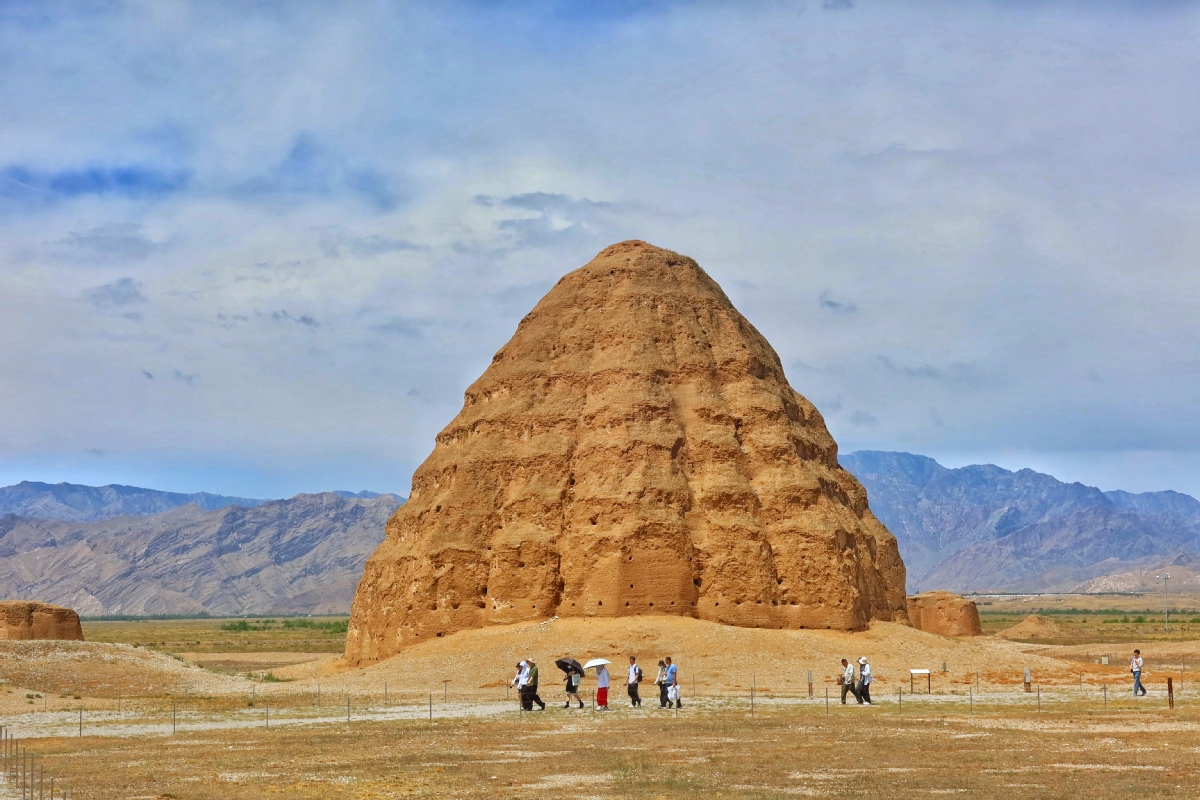
Xixia Imperial Tombs
Introduction
The Xixia Imperial Tombs, a significant archaeological and cultural heritage site, are located in the Ningxia Hui autonomous region in northwestern China. These tombs represent the remnants of the Xixia Dynasty, which was established by the Tangut people and flourished between 1038 and 1227. The burial complex spans approximately 40 square kilometers in the Gobi Desert, featuring nine imperial mausoleums and 271 subordinate tombs. The tombs serve as a testament to the cultural fusion and innovation resulting from the interaction of diverse ethnic groups during the Xixia Dynasty. In recognition of their universal significance, the Xixia Imperial Tombs were inscribed on the World Heritage List during the 47th Session of the World Heritage Committee of UNESCO in Paris, becoming China's 60th World Heritage site.
History
The Xixia Imperial Tombs trace back to the Xixia Dynasty, a regional power that emerged in the 11th century in Northwest China. The dynasty was founded by the Tangut people, a distinct ethnic group originating from the Qinghai-Tibet Plateau. The Xixia Dynasty ruled an expansive area, reaching up to 1.15 million square kilometers at its peak. Despite its significance, the dynasty was not extensively documented in historical records by its successors, making the tomb complex a crucial source of historical insight. The dynasty coexisted with other prominent regimes such as the Song, Liao, and Jin dynasties, during a period of intense political and cultural exchanges. The imperial tombs were constructed following the adoption of burial practices influenced by neighboring Chinese civilizations, despite initial Tangut traditions that did not include tomb building. The dynasty ultimately fell in 1227 after a fierce resistance against the Mongol invasion led by Genghis Khan.
Location and Geography
The Xixia Imperial Tombs are situated on a proluvial fan at the eastern foothills of the Helan Mountains, within the jurisdictions of Yinchuan in the Ningxia Hui autonomous region. This region, characterized by its arid and semi-arid climate, is part of the broader Gobi Desert landscape. The tomb complex encompasses an area of approximately 40 square kilometers, featuring both natural and artificial elements that create a unique and majestic landscape. The towering Helan Mountains provide a natural shelter for the tombs, offering protection from harsh environmental conditions. The proluvial fan's gravel and coarse sand lead to excellent drainage conditions, which were strategically utilized in the design of the tombs, reflecting the principles of traditional Chinese geomancy, or feng shui.
Architecture
Tomb Structures
The architectural layout of the Xixia Imperial Tombs reveals a blend of influences from various Chinese dynasties, particularly the Tang and Song. The complex consists of nine imperial mausoleums, each marking the burial site of Xixia rulers, alongside 271 subordinate tombs. The tombs are traditionally symmetrical along an axis, a characteristic that echoes the architectural practices of China’s Central Plains. However, the Xixia people introduced unique structural deviations, such as the alignment of the sacrificial hall, burial chamber, mound, and pagoda along a skewed line. This layout reflects the convergence of Tangut beliefs and traditional practices, and showcases their adaptability and creativity in architectural design.
Design Elements
The design elements of the Xixia Imperial Tombs demonstrate a fusion of cultural influences and architectural ingenuity. The tombs employ pagodas instead of the shrines typically found in Tang and Song mausoleums, serving as distinctive markers of Tangut burial customs. The integration of Buddhist motifs, such as the sculptures of Kalavinka, highlights the cultural exchanges facilitated by the Silk Road. The arc-shaped corner towers of Mausoleum No 3 suggest influences from West Asian battlements, which contrast with the prevalent square-shaped structures in ancient China. These design elements underscore the Xixia Dynasty's role as a cultural bridge between different civilizations.
Cultural Significance
The Xixia Imperial Tombs are a crucial witness to the cultural fusion and innovation that characterized the Xixia Dynasty. As a distribution center on the Silk Roads during the 11th to 13th centuries, the dynasty served as a melting pot of diverse ethnic groups, modes of livelihoods, and cultures. The tombs stand as a testament to the dynasty's ability to assimilate external influences while preserving its unique identity. The inscription of the Xixia Imperial Tombs as a World Heritage site signifies their outstanding universal value, reflecting the shared historical memory of the Chinese nation and the collective creativity of China's ethnic groups.
Preservation Efforts
Preservation efforts for the Xixia Imperial Tombs have been ongoing since the 1970s, with significant progress achieved in recent decades. China's National Cultural Heritage Administration and local governments have implemented comprehensive protective systems and rules to ensure the site's authenticity and integrity. Conservation experts have contributed advanced techniques for protecting the earthen sites, addressing challenges such as erosion, water damage, and structural instability. Collaborative efforts with institutions like the Dunhuang Academy have led to successful restoration methods, such as complementing eroded bases with materials that mimic ancient construction techniques. The site is now in a new phase of preventive protection, with continuous monitoring by human patrols and machines.
Tourism
The Xixia Imperial Tombs have become a popular tourist attraction, drawing visitors interested in exploring the rich history and cultural heritage of the Xixia Dynasty. The Ningxia Western Xia Imperial Tombs Archaeological Site Park offers a comprehensive experience, with museums and exhibitions that showcase artifacts and relics unearthed from the site. Efforts to manage tourism include setting visitor caps and relocating modern facilities to minimize disturbances to the site. The park provides a unique opportunity for tourists to immerse in the Silk Road culture and gain insights into the historical significance of the Xixia Imperial Tombs.








